
How to Outline Your First Book in 30 Minutes
“Just start writing and see where it goes.”
It sounds so romantic doesn’t it. Just let the story come. Let the characters speak.
Here is what actually happens. You have a great time for the first three chapters. Then around chapter seven the story starts to tangle. You lose the thread. The momentum drops. And the book ends up sitting in a folder on your desktop, half finished, while you tell yourself you just aren’t disciplined enough.
That is not what happened. You just needed a roadmap before you started driving.
In the writing world, people who write without a plan are called pantsers. As in, flying by the seat of their pants. It works for some writers who have spent decades internalising story structure. For a first time author, it is a recipe for a half finished manuscript. I see it every single week.
So here is what I teach instead. The 3-Act Post-It Method. It takes 30 minutes, it costs almost nothing, and it will give you a complete blueprint for your book before you write a single word.
An Outline Is Not a Cage
The first thing I hear when I tell a client they need to outline is “but Vicki, won’t that kill my creativity?”
I want you to shift how you see it.
You wouldn’t show up to an empty lot with a pile of wood and just see where the house takes you. You’d end up with something wobbly that falls in the first storm. You need a blueprint first. Once the structure is solid, then you get to choose everything else. The paint colours, the furniture, the garden. All the creative decisions that make it yours.
An outline does that for your book. It handles the structure so every bit of your creative energy can go into making each scene as good as it can be. You will never sit down to write and waste an hour staring at the page wondering what comes next. You already know what comes next. You get to focus on making it sing.
What You Need
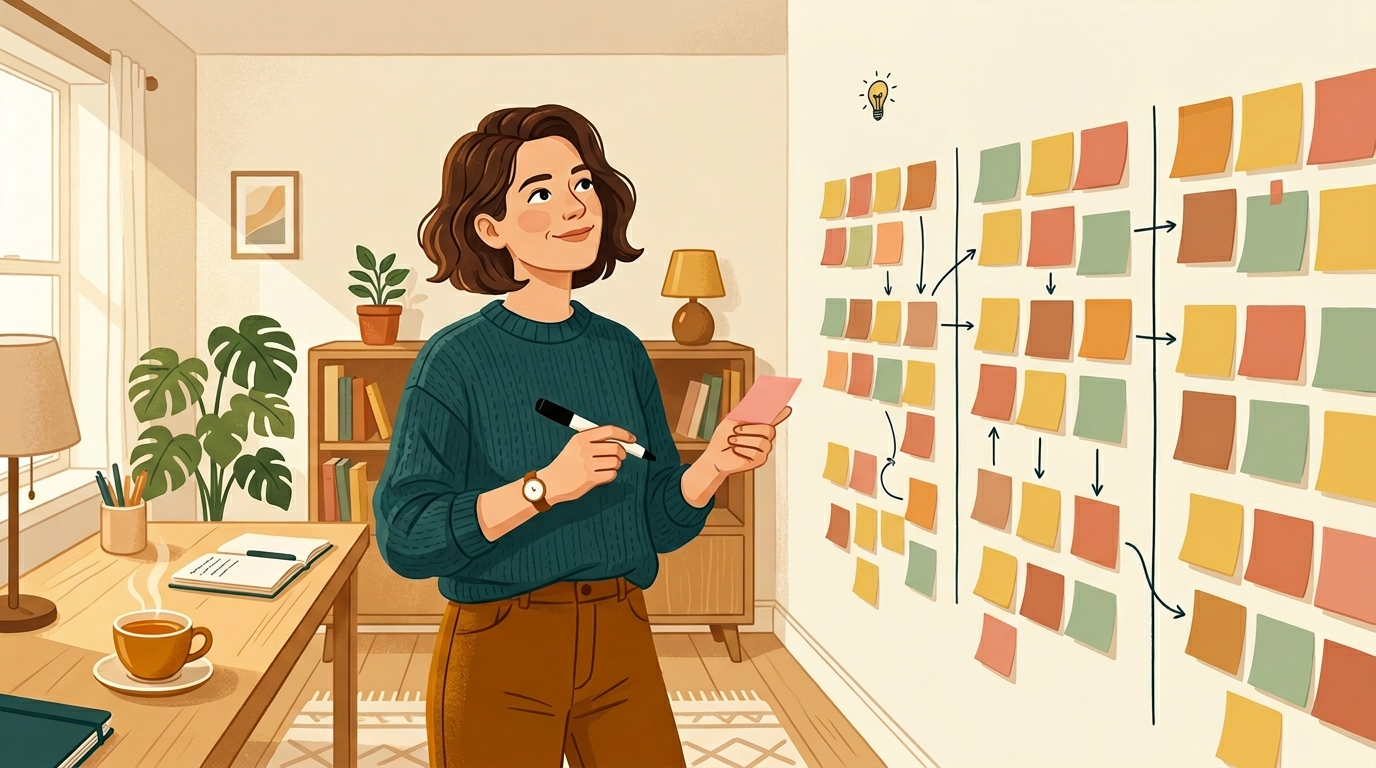
Three things. A blank wall. A pack of sticky notes. A thick marker. That is it. Do this physically, not on a screen. There is something about having your hands on the story that makes it click in a way a spreadsheet never will.
Step One: The Brain Dump
Right now your book is a swirling cloud of ideas. A strong opening scene. A plot twist you love. A vague sense of how it ends. A line of dialogue that came to you in the shower at 6am.
Get it all out. One idea per sticky note. Don’t filter, don’t order, don’t judge. Just empty your head onto the wall. You might end up with 20 notes or you might end up with 50. Both are fine. The goal is to get the cloud out of your brain and into the physical world where you can actually work with it.
Step Two: Structure the Wall
Every story follows a three-act structure. Beginning, middle, end. Divide your wall into three sections.
Act One is the setup. We meet your character, see their world, and something happens that pulls them into the story. This is the first 25% of your book.
Act Two is the journey. Your character tries, fails, learns, and faces things getting harder before they get better. This is the heart of the book, about 50%.
Act Three is the resolution. The climax, the truth, and the character arriving somewhere completely new. The final 25%.
Now sort your notes into the right sections. Something useful happens the moment you do this. You will see the gaps. If you have 30 notes in Act One and 3 in Act Two your beginning is bloated and your middle is empty. You can fix that right now, before you have written a single word of your actual book.
Step Three: Connect the Dots
Once the notes are roughly sorted, arrange them in the order the story needs to flow. This is why sticky notes are better than a document. If you realise the argument needs to happen before the farewell for the emotional impact to land, you just peel the note off and move it. No rewriting. No untangling. Just move the note.
Fill any gaps you find as you go. When the story makes sense from left to right, pull the notes down in order and type them into a document.
That is your outline. Done in 30 minutes.
Now You Have to Write Page One
You have your roadmap. The next step is sitting down and actually starting.
That is where most first time authors freeze. The gap between planning and drafting is real, and it is where a lot of books quietly stop.
The women who finish their books are not more talented than you. They are not less afraid. They just decided that the story mattered more than the fear.
If you want help taking that first step, I have a free 5-Day Book Starter Challenge. We take your outline, get clear on your reader, face the blank page together, and get your first real writing session done. It is delivered by email and it is free.
Your story is waiting. Start here.